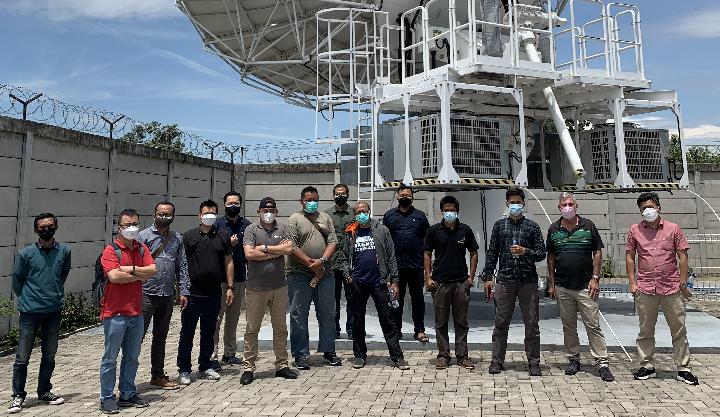





JAKARTA – The Telecommunications and Information Accessibility Agency (Bakti) is carefully calculating the deployment of Remote Terminal Ground Segment (RTGS) receivers—devices to capture signals from the Satria Satellite—across 37,000 remote locations.
Bakti’s President Director, Fadhilah Mathar, stated that the agency is conducting meticulous planning and evaluation for the deployment of RTGS units at new locations that will be connected to Satria-1. For the satellite’s ground stations (gateways), Bakti has prepared installations in 11 cities across Indonesia’s major islands, including the main gateway in Cikarang, Sumatra in Batam, Kalimantan in Pontianak, Tarakan, and Banjarmasin, and in Papua in Manokwari, Timika, and Jayapura.
“These gateways will be the connecting point for RTGS internet access at the new sites,” Fadhilah told Bisnis on Thursday (30/11/2023).
Fadhilah added that for RTGS internet access at new locations, Bakti is preparing around 4,000–5,000 new sites this year. This figure is based on considerations of resource availability, implementation timelines, and product availability in the market. For the approximately 14,000 existing sites, Bakti plans a migration to connect them to Satria-1—particularly for the 11,000 locations where technology allows for such a transition.
“New sites will be rolled out gradually through to 2025, depending on the readiness of resources such as budget and human capital,” said Fadhilah.
Bakti has shown significant commitment to RTGS deployment, even suspending the Hot Backup Satellite (HBS) project to reallocate resources toward the development of ground segments.
The urgency of the HBS project has diminished following the successful launch of Satria-1 in June 2023. The Rp5.2 trillion backup satellite project was initially intended as a contingency in case of Satria-1 launch failure. French aerospace manufacturer Thales Alenia Space has since handed over Satria-1 to PT Satelit Nusantara Tiga (SNT) after successful trials. Satria-1 is now ready to serve 20,000 of the 37,000 target sites.
Thales Alenia Space’s Satria Program Manager, Marc Courbin, confirmed that the satellite passed all trials and has been handed over to SNT, which will now manage the Satria-1 satellite and network.
“With this handover, SNT assumes control, and the satellite is ready to provide internet signals to the targeted service areas,” said Marc.
Marc noted that Satria-1 has a capacity of 150 Gbps, making it the largest in Southeast Asia. With this capacity, Bakti can adjust average internet speeds per site. For low-demand areas, bandwidth can be limited, while high-demand areas can be allocated more bandwidth. Bakti targets internet speeds ranging from 3 Mbps to 20 Mbps per site based on need.
Thales Alenia Space SVP of Sales & Marketing, Martine van Schaik, emphasized the satellite’s flexibility in allocating bandwidth to the ground segment. “It’s entirely up to Bakti. If one location has few users, capacity can be reduced, and more can be added elsewhere,” she explained.
Adi Rahman Adiwoso, CEO of Pasifik Satelit Nusantara (PSN) and PT Satelit Nusantara Tiga (SNT), said Satria will initially operate with 68 Gbps, which is estimated to support 20,000 sites. However, the deployment of VSAT (Very Small Aperture Terminal) is still limited to around 4,000 units.
“In January, Bakti will prepare additional VSAT units. It’s better to proceed gradually,” Adi noted.
Ground stations, including VSATs, are essential for receiving Satria-1’s signal. In 2019, procurement plans for VSATs and supporting ground infrastructure for the Indonesian Republic Satellite (Satria) were segmented, with an initial tender for 150,000 sites. This has since been reduced to 37,000 sites, with multiple companies expected to win contracts. Ground stations function as earth terminals to receive radio signals from satellites and include equipment like VSAT parabolic antennas, Low Noise Block (LNB), Block Up Converters (BUC), modems, and routers. Contract winners must install and maintain the equipment, with potential involvement from MSMEs (Micro, Small, and Medium Enterprises) to boost local content.
In terms of pricing, in 2019, a single VSAT for 150,000 sites was estimated at US$500–1,000 (Rp7.1–14.2 million). Bakti intends to finance this through operational expenditure (opex), not capital expenditure (capex). Ian Yosef M. Edward, Head of the Center for Telecommunications Policy and Regulation Studies at Bandung Institute of Technology (ITB), said prices today could reach tens of millions of rupiah, depending on installation location.
“Costs vary by location—some require helicopter transport costing Rp30–50 million just to deliver equipment,” Ian told Bisnis on Tuesday (21/11/2023).
He also warned that Bakti should anticipate challenges in electricity availability, particularly in underdeveloped (3T) regions where power supply is unstable. Other challenges include land conditions and legal status. Land access must be secured for equipment installation.
“Maintaining remote equipment is costly. Spare parts are often unavailable on-site, and nearby locations are hard to reach. Technicians must be brought in,” Ian added.
Source: Bisnis.com